RESEARCH USE ONLY
This product is for R&D purposes only and is not approved for human or veterinary use.
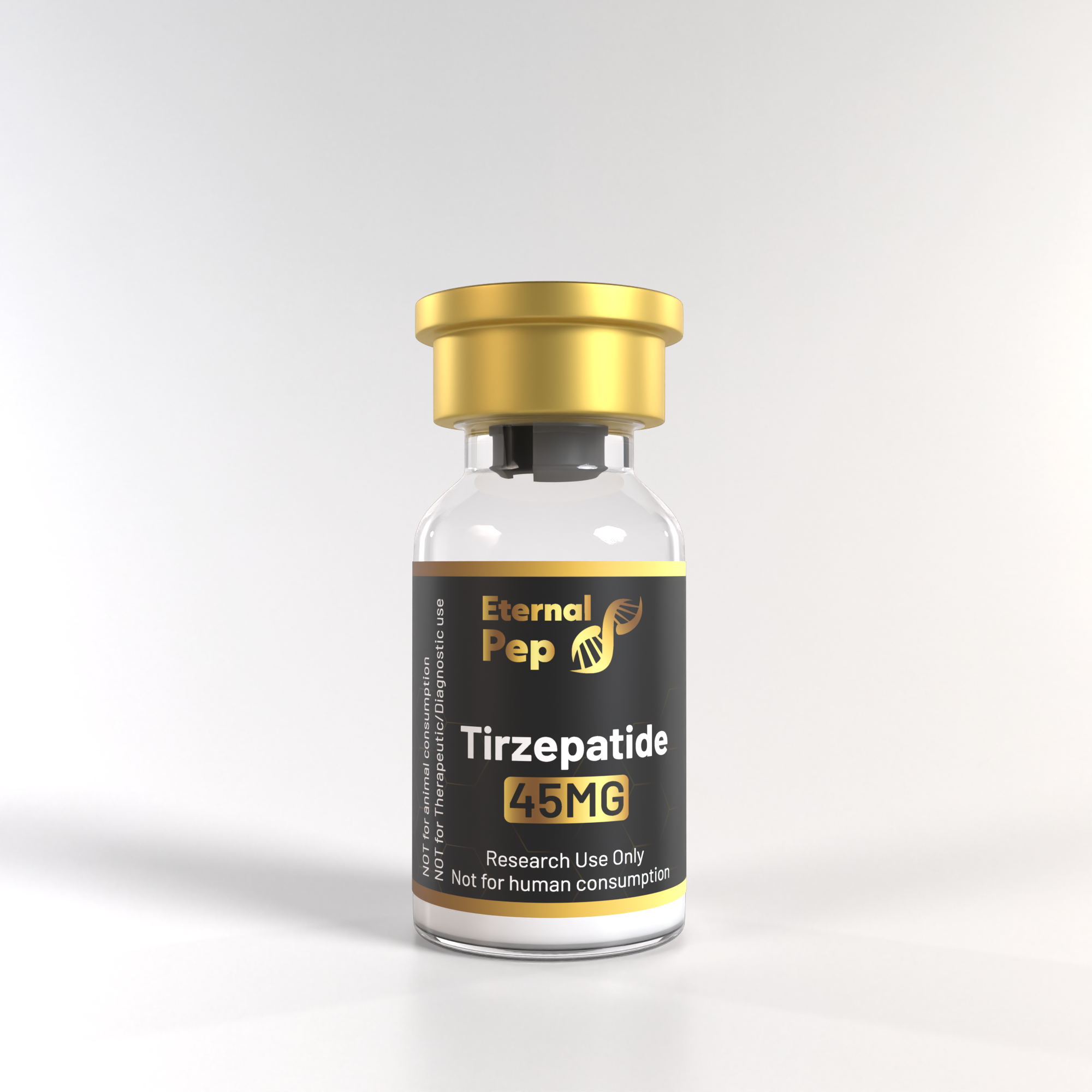
Tirzepatide 45MG — 5 Vial Bulk Pack
Tirzepatide 90mg (LY3298176) is a research-use-only dual incretin receptor agonist (GLP-1/GIP) supplied as a lyophilized vial for laboratory and
preclinical research. Not for human or veterinary use. Not for diagnostic or therapeutic purposes.
$500.00
RESEARCH USE ONLY
This product is for R&D purposes only and is not approved for human or veterinary use.
Orders placed Monday-Friday will be shipped the next business day (Excludes Holidays)
Trusted third-party testing ensures each batch’s purity and compliance with regulations.
Product List
Peptides
- AOD9604 5MG
- Bacteriostatic WATER 10ML
- BPC-157 10MG
- CJC-1295 without DAC 10MG + Ipamorelin 10MG 20MG
- GHK-Cu
- Glow Blend 70MG
- HCG 5000IU
- Ipamorelin 5MG
- Kisspeptin 10MG
- KPV 10MG
- Lipo-C 120MG/10ML
- MOTS-C 40MG
- NAD+ 1000MG (Lyophilized Powder)
- Retatrutide 20MG
- SLU-PP-332 5MG
- SS-31 10MG
- TB-500 10MG
- Tesamorelin
- Thymosin Alpha-1 10MG
- Tirzepatide 45MG
- Wolverine Stack
Product Usage Disclaimer
This product is solely intended for research purposes as a chemical compound. Its designation permits its use exclusively for in vitro testing and laboratory experimentation. All information regarding this product provided on our website is purely educational. By law, any form of bodily introduction of this product into humans or animals is strictly prohibited. It should only be handled by professionals who are licensed and qualified. This product is neither a drug, food, nor cosmetic and must not be misrepresented, misused, or mislabelled as such.
Tirzepatide 90MG
Tirzepatide (LY3298176) is a synthetic dual incretin receptor agonist peptide that activates both GLP-1 (glucagon-like peptide-1) and GIP (glucose-dependent
insulinotropic polypeptide) receptors. This product is typically supplied in a 90 mg lyophilized vial (or as part of bulk/multi-vial formats) for reconstitution
and is sold exclusively for laboratory and preclinical research purposes in accredited scientific institutions, qualified academic laboratories, or approved
research settings. It is not approved for human use, diagnostic purposes, therapeutic applications, or consumption by humans or animals.
Research Context
Tirzepatide is a first-in-class dual GLP-1/GIP receptor agonist developed by Eli Lilly and Company. It enhances incretin effects to promote insulin secretion in
a glucose-dependent manner, suppress glucagon, slow gastric emptying, reduce appetite, and support energy homeostasis. While now an approved therapeutic agent for
certain indications, research-grade forms (high-content vials like 90 mg) remain valuable for basic mechanistic studies, receptor binding assays,
pharmacokinetics/pharmacodynamics modeling, formulation development, comparative incretin research, and non-clinical models of metabolic disorders.
As of February 2026, tirzepatide is FDA-approved under the brand names:
- Mounjaro (approved May 2022) — for improving glycemic control in adults with type 2 diabetes.
- Zepbound (approved November 2023) — for chronic weight management in adults with obesity or overweight with weight-related conditions; expanded in
December 2024 to include moderate-to-severe obstructive sleep apnea in combination with diet and exercise.
Recent updates include FDA label expansion (February 23, 2026) for a multi-dose KwikPen delivering a full month’s treatment (4 doses in one single-patient-use
device). It remains the most prescribed weight management medication in the U.S. (2025 data), with ongoing real-world evidence, post-marketing studies, and
combination trials (e.g., with ixekizumab for psoriasis and obesity, showing superior skin clearance and weight loss in February 2026 Phase 3b results).
Current Research Overview (as of February 2026)
- Pivotal Phase 3 SURMOUNT trials demonstrated substantial weight loss: e.g., in SURMOUNT-1 (adults without diabetes), up to ~20.9% average body weight reduction
(≈48 lb) at 72 weeks with 15 mg dose. SURMOUNT-5 head-to-head vs. semaglutide showed ~20.2% loss (50 lb) vs. ~13.7% (33 lb). Long-term data confirm sustained
benefits and diabetes prevention. - Additional indications supported by trials: reductions in cardiometabolic risks, hepatic fat, and improvements in sleep apnea.
- Potential benefits under investigation in research settings include:
- Superior incretin-mediated effects vs. single GLP-1 agonists
- Central nervous system modulation of appetite via hypothalamic pathways
- Favorable impacts on lipid profiles, insulin sensitivity, and inflammation
- Once-weekly subcutaneous administration
Key Research Focus Areas (Updated Status)
| Research Focus | Current Status (2026) |
|---|---|
| GLP-1/GIP dual receptor agonism | Mechanism fully validated; approved therapies show potent incretin enhancement; ongoing studies in CNS, gut, and adipose tissues |
| Metabolic regulation & glycemic control | FDA-approved for type 2 diabetes (Mounjaro); sustained HbA1c reductions (1.7–2.4%) and prevention of progression in trials |
| Appetite suppression & weight management | FDA-approved for obesity/overweight (Zepbound); up to ~21% weight loss in key trials; superior to semaglutide in direct comparisons |
| Pharmacokinetics & dosing optimization | Weekly dosing established (titration from 2.5 mg to 15 mg); research explores stability, novel delivery (e.g., multi-dose pens), and analogs |
| Toxicology & safety profiling | GI side effects common (dose-related, transient); rare risks monitored (e.g., no causal link to suicidal ideation per FDA 2026 update); long-term post-marketing data accumulating |
| Comparative efficacy & combination therapies | Outperforms GLP-1-only agents; emerging combo data (e.g., with biologics for psoriasis); head-to-heads vs. emerging therapies ongoing |
Important Notes
- Approved therapeutic doses titrate up to 15 mg weekly (not 90 mg as a single dose). The 90 mg vial is common for research reconstitution, in vitro assays,
animal model dosing, bulk peptide studies, or high-throughput screening—not indicative of human clinical dosing. - Research must strictly comply with institutional, local, and international regulations for handling synthetic peptides, including proper storage (lyophilized:
frozen/refrigerated; reconstituted: refrigerated with appropriate stabilizers), reconstitution protocols (e.g., bacteriostatic water), animal welfare standards
(if applicable), and waste disposal. - Potential off-target effects, receptor specificity, and long-term impacts require rigorous controlled evaluation.
- For research use only. Not for human or veterinary use. Not for diagnostic or therapeutic purposes. Suppliers of research-grade tirzepatide assume no liability
for misuse outside legitimate laboratory environments. Obtain only from reputable vendors with third-party purity testing (e.g., ≥99% by HPLC) to ensure quality
and compliance. Beware of unregulated sources.
This update reflects the latest publicly available data from Eli Lilly announcements, FDA approvals, clinical trial results, and peer-reviewed sources through
late February 2026. For the most current information, consult primary sources such as ClinicalTrials.gov, Lilly investor releases, or FDA databases.


Reviews
There are no reviews yet.